

How Do I Find Old Tags Registered
Headings
To create a heading, add ane to half-dozen # symbols earlier your heading text. The number of # you use will determine the size of the heading.
# The largest heading ## The second largest heading ###### The smallest heading 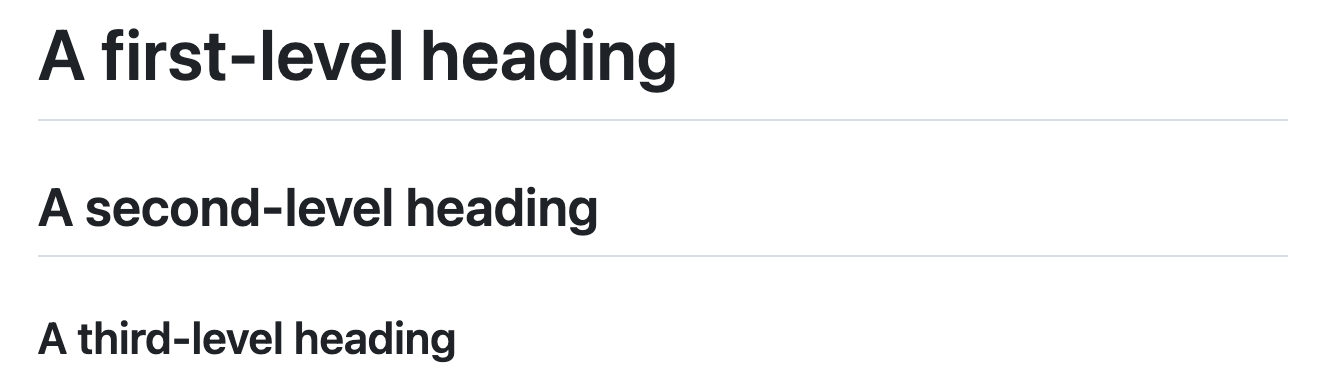
When you use two or more headings, GitHub automatically generates a table of contents which you tin can admission by clicking within the file header. Each heading title is listed in the table of contents and you tin click a championship to navigate to the selected department.

Styling text
Y'all can point emphasis with bold, italic, or strikethrough text in comment fields and .md files.
| Manner | Syntax | Keyboard shortcut | Example | Output |
|---|---|---|---|---|
| Bold | ** ** or __ __ | Command+B (Mac) or Ctrl+B (Windows/Linux) | **This is bold text** | This is bold text |
| Italic | * * or _ _ | Command+I (Mac) or Ctrl+I (Windows/Linux) | *This text is italicized* | This text is italicized |
| Strikethrough | ~~ ~~ | ~~This was mistaken text~~ | | |
| Assuming and nested italic | ** ** and _ _ | **This text is _extremely_ important** | This text is extremely of import | |
| All bold and italic | *** *** | ***All this text is important*** | All this text is important |
Quoting text
You tin can quote text with a >.
Text that is not a quote > Text that is a quote 
Tip: When viewing a chat, you can automatically quote text in a comment by highlighting the text, then typing R. You can quote an unabridged annotate by clicking , so Quote reply. For more information about keyboard shortcuts, see "Keyboard shortcuts."
Quoting code
You can call out code or a command within a sentence with single backticks. The text within the backticks will not be formatted. You tin besides press the Control+E (Mac) or Ctrl+E (Windows/Linux) keyboard shortcut to insert the backticks for a code block within a line of Markdown.
Use `git condition` to list all new or modified files that haven't yet been committed. 
To format code or text into its ain distinct cake, apply triple backticks.
Some bones Git commands are: ``` git status git add together git commit ```
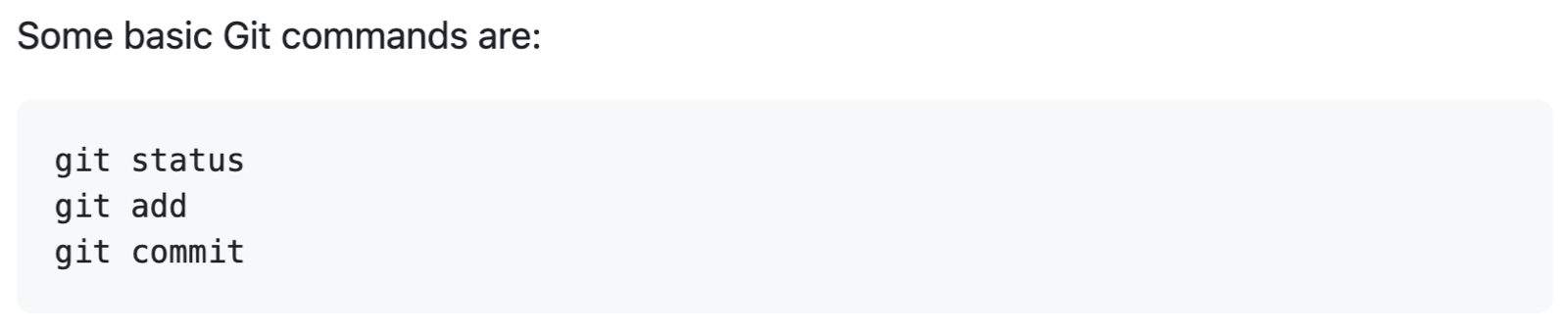
For more data, see "Creating and highlighting lawmaking blocks."
If you are frequently editing code snippets and tables, y'all may do good from enabling a fixed-width font in all comment fields on GitHub. For more than information, see "Enabling stock-still-width fonts in the editor."
Links
You can create an inline link past wrapping link text in brackets [ ], and then wrapping the URL in parentheses ( ). You can too use the keyboard shortcut Command+G to create a link. When you take text selected, y'all can paste a URL from your clipboard to automatically create a link from the selection.
This site was built using [GitHub Pages](https://pages.github.com/).

Tip: GitHub automatically creates links when valid URLs are written in a comment. For more information, run across "Autolinked references and URLs."
Section links
You can link directly to a department in a rendered file by hovering over the section heading to betrayal the link:
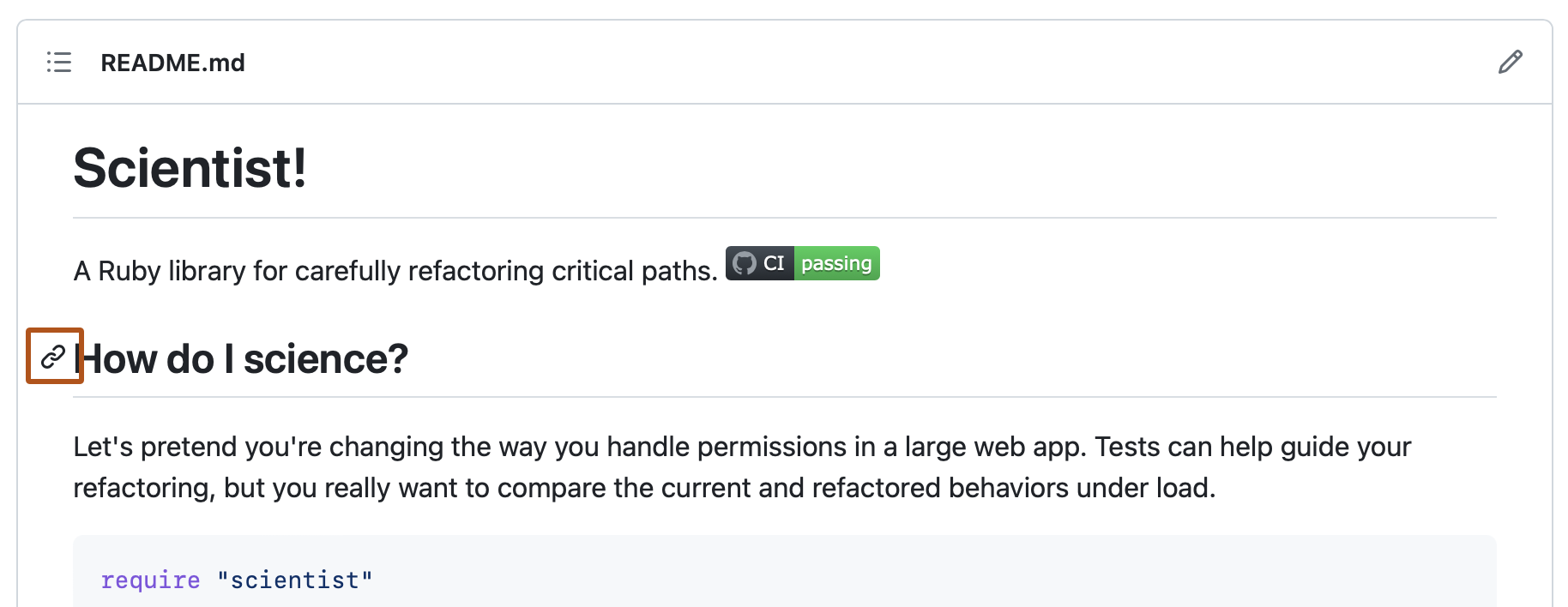
Relative links
You tin define relative links and image paths in your rendered files to help readers navigate to other files in your repository.
A relative link is a link that is relative to the current file. For example, if you have a README file in root of your repository, and y'all take another file in docs/CONTRIBUTING.physician, the relative link to CONTRIBUTING.physician in your README might look like this:
[Contribution guidelines for this projection](docs/CONTRIBUTING.md) GitHub volition automatically transform your relative link or image path based on any co-operative yous're currently on, so that the link or path always works. You can apply all relative link operands, such as ./ and ../.
Relative links are easier for users who clone your repository. Accented links may not work in clones of your repository - nosotros recommend using relative links to refer to other files within your repository.
Images
You lot can display an image by adding ! and wrapping the alt text in [ ]. Then wrap the link for the image in parentheses ().

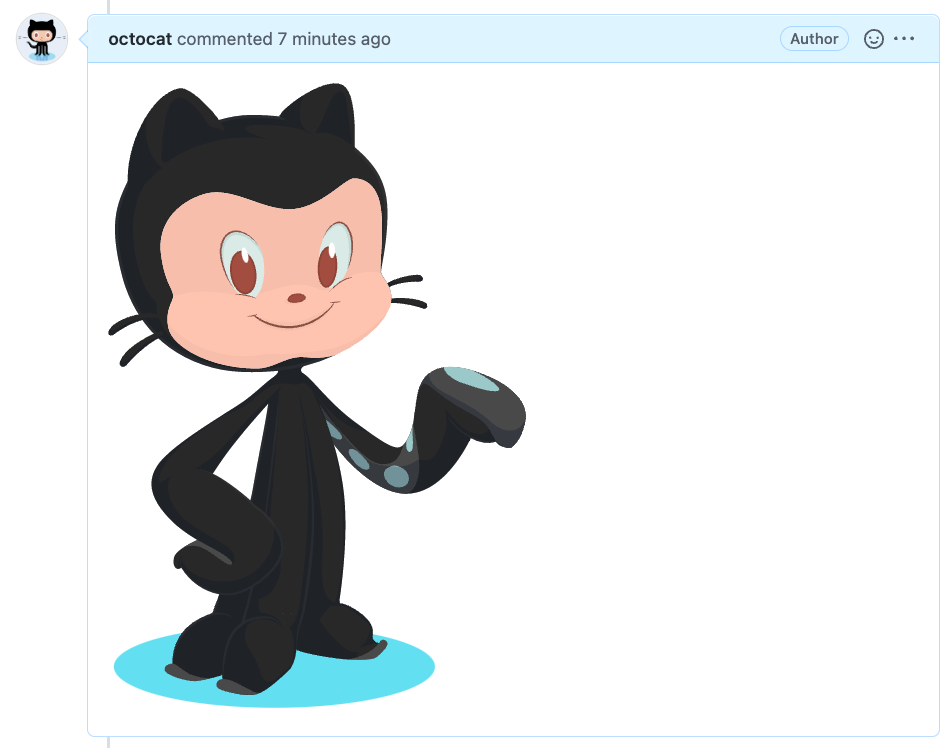
GitHub supports embedding images into your issues, pull requests, discussions, comments and .md files. You can display an image from your repository, add a link to an online image, or upload an image. For more information, see "Uploading assets."
Tip: When you desire to display an prototype which is in your repository, you should apply relative links instead of absolute links.
Here are some examples for using relative links to display an image.
| Context | Relative Link |
|---|---|
In a .md file on the aforementioned branch | /assets/images/electrocat.png |
In a .medico file on another co-operative | /../chief/avails/images/electrocat.png |
| In problems, pull requests and comments of the repository | ../blob/main/assets/images/electrocat.png |
In a .md file in some other repository | /../../../../github/docs/hulk/main/avails/images/electrocat.png |
| In problems, pull requests and comments of another repository | ../../../github/docs/blob/main/assets/images/electrocat.png?raw=true |
Notation: The final 2 relative links in the table above will work for images in a individual repository but if the viewer has at to the lowest degree read access to the private repository which contains these images.
For more data, see "Relative Links."
Specifying the theme an image is shown to
You lot can specify the theme an prototype is displayed to by appending #gh-nighttime-style-only or #gh-low-cal-mode-just to the end of an image URL, in Markdown.
Nosotros distinguish betwixt light and dark color modes, and so at that place are 2 options bachelor. You tin can use these options to display images optimized for nighttime or light backgrounds. This is particularly helpful for transparent PNG images.
| Context | URL |
|---|---|
| Dark Theme |  |
| Low-cal Theme |  |
Lists
You tin can make an unordered list past preceding one or more lines of text with - or *.
- George Washington - John Adams - Thomas Jefferson 
To order your list, precede each line with a number.
1. James Madison two. James Monroe iii. John Quincy Adams 
Nested Lists
You lot tin create a nested list by indenting one or more than list items beneath another detail.
To create a nested list using the spider web editor on GitHub or a text editor that uses a monospaced font, like Atom, you can marshal your list visually. Type space characters in front of your nested list detail, until the list marker character (- or *) lies directly beneath the first grapheme of the text in the item higher up it.
1. First listing item - First nested list item - Second nested list item 

To create a nested list in the comment editor on GitHub, which doesn't apply a monospaced font, you lot can expect at the list item immediately in a higher place the nested list and count the number of characters that appear before the content of the particular. Then type that number of space characters in front end of the nested list item.
In this example, you could add a nested listing item nether the list particular 100. Showtime list item by indenting the nested list item a minimum of v spaces, since there are five characters (100. ) before Starting time list item.
100. Kickoff list particular - First nested list particular 
Yous can create multiple levels of nested lists using the same method. For example, because the first nested listing item has 7 characters (␣␣␣␣␣-␣) before the nested list content Beginning nested list item, you would demand to indent the second nested listing item by seven spaces.
100. Commencement list item - Outset nested list detail - Second nested listing detail 
For more examples, see the GitHub Flavored Markdown Spec.
Chore lists
To create a chore list, preface listing items with a hyphen and infinite followed by [ ]. To marker a job as complete, use [10].
- [10] #739 - [ ] https://github.com/octo-org/octo-repo/issues/740 - [ ] Add delight to the experience when all tasks are complete :tada: 
If a chore list particular description begins with a parenthesis, you'll need to escape it with \:
- [ ] \(Optional) Open a followup issue
For more than information, run across "About chore lists."
Mentioning people and teams
Y'all can mention a person or team on GitHub past typing @ plus their username or squad name. This will trigger a notification and bring their attention to the conversation. People volition also receive a notification if you edit a annotate to mention their username or team proper name. For more than information about notifications, see "Almost notifications."
@github/support What do you lot think virtually these updates?

When yous mention a parent squad, members of its child teams as well receive notifications, simplifying communication with multiple groups of people. For more information, see "About teams."
Typing an @ symbol will bring up a list of people or teams on a project. The list filters equally you type, then once you lot notice the name of the person or team y'all are looking for, y'all tin utilise the arrow keys to select it and press either tab or enter to complete the proper name. For teams, enter the @arrangement/team-name and all members of that team will get subscribed to the conversation.
The autocomplete results are restricted to repository collaborators and whatsoever other participants on the thread.
Referencing issues and pull requests
Y'all can bring up a listing of suggested issues and pull requests within the repository by typing #. Type the issue or pull request number or title to filter the list, and so press either tab or enter to complete the highlighted result.
For more information, run across "Autolinked references and URLs."
Referencing external resources
If custom autolink references are configured for a repository, then references to external resources, similar a JIRA issue or Zendesk ticket, convert into shortened links. To know which autolinks are available in your repository, contact someone with admin permissions to the repository. For more data, see "Configuring autolinks to reference external resources."
Uploading avails
Y'all can upload assets similar images by dragging and dropping, selecting from a file browser, or pasting. Y'all can upload assets to bug, pull requests, comments, and .physician files in your repository.
Using emoji
You can add emoji to your writing past typing :EMOJICODE:.
@octocat :+1: This PR looks bang-up - it's ready to merge! :shipit:

Typing : will bring upwardly a list of suggested emoji. The listing will filter every bit you type, then once you notice the emoji you're looking for, press Tab or Enter to complete the highlighted effect.
For a full listing of available emoji and codes, bank check out the Emoji-Cheat-Sheet.
Paragraphs
You can create a new paragraph past leaving a blank line betwixt lines of text.
You tin can add footnotes to your content past using this bracket syntax:
Here is a unproblematic footnote[^one]. A footnote tin as well have multiple lines[^2]. Y'all can also use words, to fit your writing style more closely[^notation]. [^1]: My reference. [^2]: Every new line should be prefixed with 2 spaces. This allows you lot to take a footnote with multiple lines. [^notation]: Named footnotes will still render with numbers instead of the text merely allow easier identification and linking. This footnote too has been made with a different syntax using iv spaces for new lines. The footnote will render like this:

Note: The position of a footnote in your Markdown does not influence where the footnote will be rendered. You tin write a footnote right afterwards your reference to the footnote, and the footnote volition still return at the bottom of the Markdown.
Hiding content with comments
You lot tin tell GitHub to hide content from the rendered Markdown past placing the content in an HTML comment.
<!-- This content will not appear in the rendered Markdown -->
Ignoring Markdown formatting
You can tell GitHub to ignore (or escape) Markdown formatting past using \ before the Markdown grapheme.
Let'south rename \*our-new-project\* to \*our-onetime-projection\*.

For more information, see Daring Fireball'south "Markdown Syntax."
Disabling Markdown rendering
When viewing a Markdown file, you can click at the pinnacle of the file to disable Markdown rendering and view the file's source instead.

Disabling Markdown rendering enables you to employ source view features, such as line linking, which is non possible when viewing rendered Markdown files.
Farther reading
- GitHub Flavored Markdown Spec
- "Most writing and formatting on GitHub"
- "Working with advanced formatting"
- "Mastering Markdown"

Source: https://docs.github.com/en/get-started/writing-on-github/getting-started-with-writing-and-formatting-on-github/basic-writing-and-formatting-syntax
Posted by: whitehonsintepher.blogspot.com
0 Response to "How Do I Find Old Tags Registered"
Post a Comment